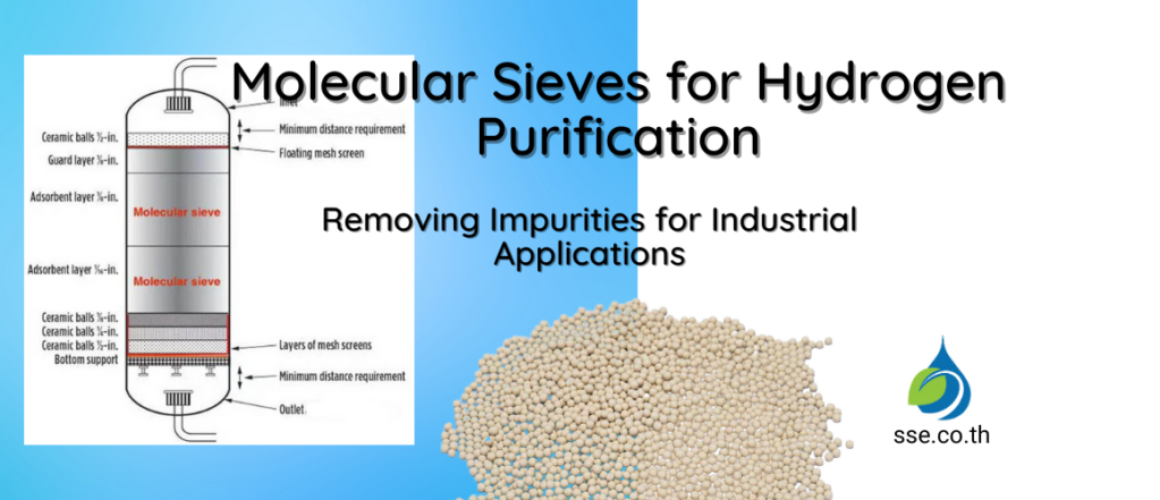
Molecular Sieves for Hydrogen Purification: Practical Selection Guide for Industrial Gas Treatment

Everything You Need to Know at a Glance
| Item | Summary |
|---|---|
| Product/topic | Molecular sieves for hydrogen purification and gas polishing |
| Best used for | Removing moisture, CO₂, and selected impurities from hydrogen-containing gas streams, depending on system design |
| Main problem solved | Helps protect downstream equipment, catalysts, fuel cells, and gas processes from contamination caused by water vapor and other adsorbable impurities |
| Typical users | Hydrogen producers, petrochemical plants, industrial gas suppliers, fuel cell system integrators, research facilities, and chemical processing plants |
| Key selection factors | Feed gas composition, target purity, impurity type, pressure, temperature, flow rate, bed design, regeneration method, bead size, and required documentation |
| When to contact SSE | When you are not sure whether 5A, 13X, or another adsorbent type is suitable for your hydrogen stream, or when you need help choosing quantity, packaging, bead size, or bulk supply options |
Table Of Contents
What Molecular Sieves Do in Hydrogen Purification
Molecular sieves are crystalline adsorbents with very small, uniform pores. They are used in many gas drying, purification, and separation processes because they can adsorb certain molecules more strongly than others.
In hydrogen purification, molecular sieves are often used to help remove moisture, carbon dioxide, and other impurities from hydrogen-containing gas streams. The exact result depends on the feed gas, the system design, the adsorbent type, and the operating conditions.
Hydrogen itself is small and weakly adsorbed compared with many common contaminants. In a properly designed adsorption process, impurities are retained in the adsorbent bed while the hydrogen-rich gas passes through.
For a broader explanation of molecular sieve types and how they work, see SSE’s comprehensive guide to molecular sieves.
Molecular sieves are not a one-size-fits-all hydrogen purification product. The correct type depends on what needs to be removed, not only on the fact that the gas stream contains hydrogen.
Why Hydrogen Purity Matters
Hydrogen is used in different industrial applications, and each application has its own purity requirements. A petrochemical process may tolerate a different impurity profile than a PEM fuel cell system. A research laboratory may also have different requirements from a bulk industrial gas user.
Common reasons for controlling hydrogen purity include:
- Protecting catalysts from poisoning or loss of activity
- Reducing moisture-related corrosion or process instability
- Improving consistency in downstream chemical reactions
- Protecting sensitive fuel cell components
- Meeting customer or project specifications
- Reducing the risk of off-spec gas quality
For fuel cell use, hydrogen quality requirements can be strict. The current ISO hydrogen fuel quality standard is ISO 14687:2025. For technical background on how contaminants may affect PEM fuel cells, the U.S. Department of Energy report on hydrogen fuel quality specifications for PEM fuel cells is also useful.
Common Impurities in Hydrogen Gas Streams
Hydrogen streams may contain different impurities depending on the production method, upstream process, compression system, storage system, and piping condition.
| Impurity | Why it matters | Molecular sieve relevance |
|---|---|---|
| Water vapor | Can affect catalysts, equipment, analytical accuracy, and gas quality | Molecular sieves are commonly used for deep drying |
| CO₂ | Can affect gas purity and downstream process performance | 13X is commonly considered for CO₂ adsorption |
| CO | Can be harmful in some fuel cell and catalyst applications | Removal depends on system design and adsorbent selection; do not assume a simple dryer bed is enough |
| Nitrogen | May reduce hydrogen purity by dilution | May require PSA or another separation process |
| Methane and light hydrocarbons | May be present depending on hydrogen source | Removal depends on process design and adsorbent combination |
| Sulfur compounds | Can poison catalysts and sensitive systems | May require specific upstream treatment or guard beds |
| Oxygen | May create safety and quality concerns | Requires proper process control and gas analysis |
Before choosing a molecular sieve, identify the impurity problem clearly. “Hydrogen purification” can mean moisture removal, CO₂ removal, fuel cell polishing, PSA separation, or general gas drying. These are not the same job.
5A vs 13X Molecular Sieves for Hydrogen Purification
Two molecular sieve types often discussed for hydrogen-related gas treatment are 5A and 13X. They have different pore structures and adsorption behavior, so the best choice depends on the impurity profile and the equipment design.
| Molecular sieve type | Typical role in gas treatment | Where it may fit in hydrogen purification | Notes for buyers |
|---|---|---|---|
| 5A molecular sieve | Gas drying and selective adsorption of certain small molecules | May be considered in PSA or gas polishing systems depending on feed composition | Selection should be based on impurity type, operating pressure, and system design |
| 13X molecular sieve | Strong adsorption of water and CO₂; broad gas purification use | Often considered where CO₂ and moisture removal are important | Can be useful in gas purification beds, but must be checked against the target gas specification |
| Layered adsorbent bed | Uses more than one adsorbent type in sequence | May be used when the gas contains moisture, CO₂, hydrocarbons, sulfur compounds, or other mixed contaminants | Bed design should be handled carefully by the system designer or process engineer |
SSE supplies molecular sieve products and related technical information, including Molecular Sieve 5A 1.6–2.5 mm in 30 kg drum and information on 13X molecular sieves.
How Molecular Sieves Work in Adsorption Systems
Molecular sieves remove impurities by adsorption. Adsorption means the impurity molecules attach to the internal surface of the adsorbent. This is different from absorption, where a substance is taken into the bulk of another material.
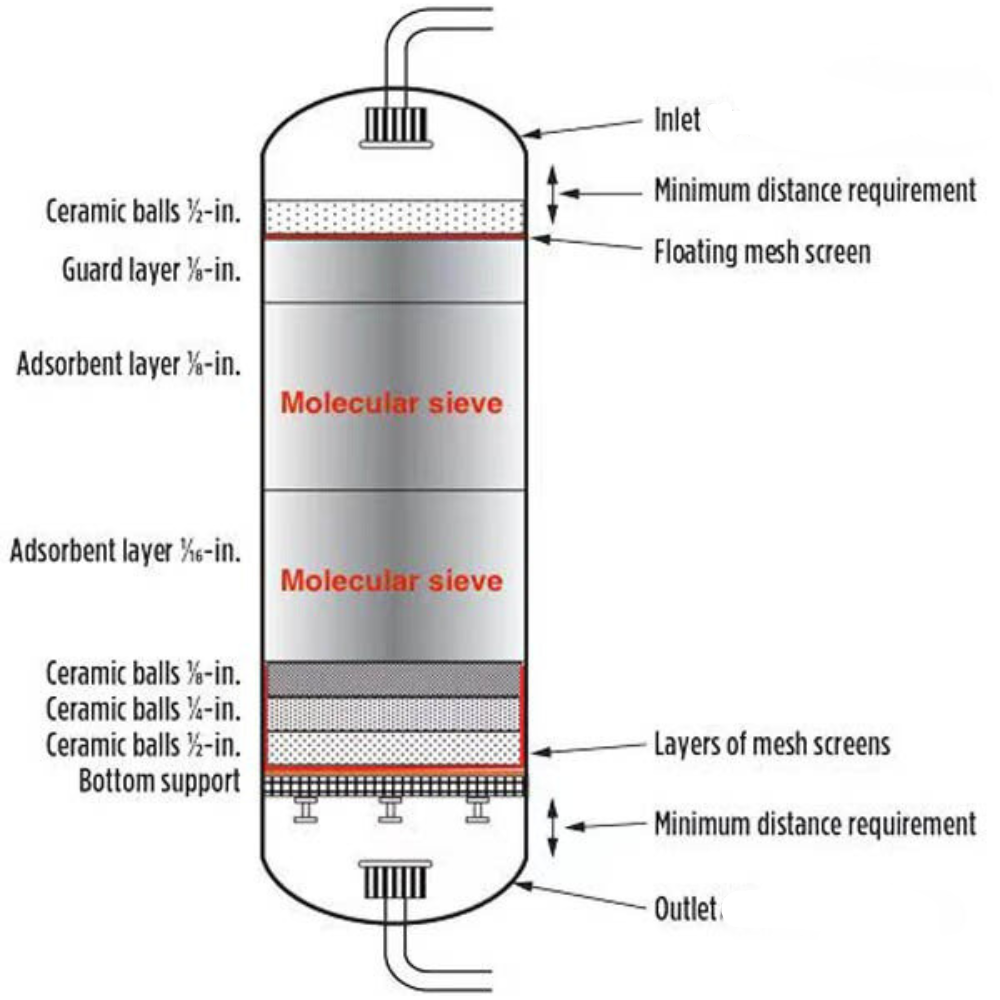
In gas purification systems, the adsorbent is usually packed inside a vessel, column, cartridge, or tower. The gas passes through the bed, and selected impurities are retained until the bed becomes loaded. After that, the bed must be replaced or regenerated, depending on the system design.
Common system types include:
| System type | How it works | Typical use |
|---|---|---|
| Fixed bed dryer or purifier | Gas passes through a packed bed until the bed is saturated | Moisture removal, gas polishing, small to medium gas treatment |
| Twin-tower dryer | One tower treats gas while the other tower regenerates | Continuous gas drying |
| PSA system | Uses pressure changes to adsorb and release selected gases | Hydrogen purification, oxygen generation, nitrogen generation, and other gas separation duties |
| TSA system | Uses heat to regenerate the adsorbent | Deep drying and some purification processes |
| Guard bed | Protects downstream equipment by removing a specific contaminant before it reaches sensitive equipment | Catalyst protection, polishing before analyzers, fuel cell protection |
For a wider view of adsorption, gas drying, and separation processes, see SSE’s guide to key molecular sieve processes and the article on gas separation with molecular sieve.
Practical Selection Factors
Choosing the right molecular sieve for hydrogen purification requires more than selecting “5A” or “13X” from a product list. The process conditions matter.
| Selection factor | Why it matters | Information to prepare |
|---|---|---|
| Feed gas composition | The adsorbent must match the impurities present | H₂ %, water, CO₂, CO, CH₄, N₂, O₂, sulfur compounds, and other known impurities |
| Target gas quality | Different applications require different purity levels | Required outlet purity or customer specification |
| Flow rate | Affects bed size and contact time | Normal and maximum flow rate |
| Pressure | Adsorption behavior changes with pressure | Operating pressure and pressure variation |
| Temperature | Affects adsorption capacity and regeneration | Normal and maximum temperature |
| Current bed design | Replacement quantity depends on vessel size and packing | Vessel diameter, bed depth, adsorbent volume, and existing media type |
| Regeneration method | Determines whether the sieve can be reused in the system | PSA, TSA, purge gas, vacuum, heat, or replacement-only |
| Bead size | Affects pressure drop and mass transfer | Current bead size, if replacing existing media |
| Documentation needs | Procurement and engineering teams may need documents before approval | Specification, COA, MSDS, quotation, and packing details |
Practical Application Examples
Example 1: Hydrogen gas drying before downstream use
A factory receives hydrogen gas that meets general purity requirements but has a moisture issue after compression or storage. In this case, the main target may be water vapor removal rather than full gas separation.
A molecular sieve dryer may be suitable, but SSE would need to know the pressure, flow rate, target dew point, gas temperature, and whether the dryer is disposable, regenerable, or part of a twin-tower system.
Example 2: CO₂ removal from a hydrogen-rich stream
A hydrogen-rich process gas contains CO₂ after upstream processing. 13X molecular sieve may be considered because it is widely used for CO₂ adsorption in gas purification. However, the correct bed design depends on CO₂ concentration, moisture content, temperature, pressure, and target outlet specification.
This is not simply a matter of adding a bag of desiccant into a line. It requires a proper vessel, suitable contact time, and safe process design.
Example 3: Hydrogen purification for fuel cell-related use
Fuel cell applications may require very low contaminant levels. Molecular sieves can be part of a purification or polishing system, especially for moisture and CO₂ control, but they should not be presented as a complete guarantee of fuel-cell-grade hydrogen.
For fuel cell projects, SSE should be given the gas analysis, target standard, system design, and required documents before recommending a product type.
Example 4: Replacement media for an existing adsorption tower
A customer may already have a hydrogen purification unit and only needs replacement molecular sieve. In this case, the best starting point is the existing media type, bead size, vessel dimensions, and operating conditions.
If the original adsorbent type is unknown, a sample photo, old specification sheet, or equipment manual can help narrow down the correct replacement.
Advantages of Molecular Sieves in Hydrogen Gas Treatment
Molecular sieves are widely used because they offer practical benefits in industrial gas systems.
| Advantage | Customer benefit |
|---|---|
| Strong moisture adsorption | Helps produce dry hydrogen or protect downstream equipment |
| Selective adsorption | Helps target specific impurities when matched correctly |
| Suitable for packed beds | Can be used in columns, dryers, cartridges, towers, and PSA systems |
| Regeneration possible in suitable systems | Can reduce replacement frequency when the system is designed for regeneration |
| Multiple types available | Allows selection based on impurity size, polarity, and process conditions |
| Industrial packaging options | Suitable for maintenance teams, project purchases, and bulk replacement work |
Limitations and Common Mistakes
Molecular sieves are useful, but they should be applied correctly.
Common mistakes include:
- Selecting 5A or 13X without checking the gas composition
- Assuming one adsorbent can remove every impurity
- Ignoring moisture load before CO₂ or trace impurity removal
- Replacing media without checking bead size and pressure drop
- Using a non-regenerable setup where regeneration is required
- Forgetting to confirm the required outlet gas quality
- Treating fuel cell hydrogen polishing the same as ordinary gas drying
If the application involves fuel cells, catalysts, or high-purity gas supply, do not rely only on product name selection. Confirm the impurity limits, test method, and system design before purchasing.
Regeneration and Handling
Many molecular sieve systems are designed for regeneration. Regeneration removes adsorbed molecules so the sieve can be reused. Depending on the process, regeneration may use heat, pressure reduction, purge gas, vacuum, or a combination of methods.
Important handling points:
- Keep molecular sieves sealed before use.
- Avoid long exposure to open air because they can adsorb moisture quickly.
- Store in a dry area.
- Use the correct bead size to avoid pressure-drop problems.
- Follow the equipment maker’s instructions for loading, startup, and regeneration.
- Replace contaminated media if oil, liquid water, or process chemicals have damaged the bed.
For more information, see SSE’s article on regeneration and reuse of molecular sieves.
Buying Guidance: What to Send SSE Before Ordering
To help SSE recommend a practical option, send as much of the following information as possible.
| Information needed | Example |
|---|---|
| Application | Hydrogen drying, CO₂ removal, PSA unit, polishing bed, fuel cell supply, catalyst guard bed |
| Gas composition | H₂ %, moisture, CO₂, CO, CH₄, N₂, O₂, sulfur compounds |
| Flow rate | Nm³/h, L/min, kg/h, or other available unit |
| Pressure and temperature | Normal operating range and maximum values |
| Target outlet quality | Dew point, ppm moisture, CO₂ limit, fuel cell standard, or customer specification |
| Existing media | 5A, 13X, activated alumina, carbon, unknown, or mixed bed |
| Bead size | 1.6–2.5 mm, 3.0–5.0 mm, or other size |
| Required quantity | Drum quantity, kg, bed volume, or vessel dimensions |
| Documents needed | Specification, COA, MSDS, quotation, delivery document |
| Delivery location in Thailand | Province, industrial estate, or factory location |
SSE can support industrial customers in Thailand with practical product advice, fast delivery, bulk orders, custom requirements, and free shipping when applicable.
Frequently Asked Questions
What molecular sieve is used for hydrogen purification?
5A and 13X molecular sieves are commonly discussed for hydrogen gas treatment, but the correct choice depends on the impurities that must be removed. 13X is often considered for CO₂ and moisture removal, while 5A may be considered in certain gas separation or polishing systems.
Can molecular sieves remove moisture from hydrogen?
Yes. Molecular sieves are commonly used for deep drying of gases, including hydrogen-containing streams. The final moisture level depends on the system design, bed size, operating conditions, and regeneration method.
Can molecular sieves remove CO₂ from hydrogen?
13X molecular sieve is commonly used for CO₂ adsorption in gas purification. For hydrogen purification, the feed composition and target outlet specification must be checked before selecting the adsorbent.
Can molecular sieves remove carbon monoxide from hydrogen?
CO removal is more system-dependent than moisture or CO₂ removal. It may require a PSA design, a specific adsorbent combination, or other purification steps. Do not assume that a simple molecular sieve dryer will remove CO to fuel-cell-grade levels.
Is molecular sieve enough to make fuel-cell-grade hydrogen?
Not by itself in most cases. Fuel-cell-grade hydrogen must meet strict impurity requirements. Molecular sieves may be part of the purification system, but gas analysis, system design, and testing are needed.
Can molecular sieves be regenerated?
Yes, if the system is designed for regeneration. Common regeneration methods include heat, pressure swing, purge gas, vacuum, or a combination of these methods.
What information does SSE need to recommend the right molecular sieve?
SSE needs to know the application, feed gas composition, flow rate, pressure, temperature, target outlet quality, current media type, bead size, required quantity, and documentation requirements.
Contact SSE for Molecular Sieve Advice
Hydrogen purification is a technical application, and the right adsorbent depends on the gas stream, target purity, and equipment design.
Contact SSE if you are not sure which molecular sieve type or quantity is suitable for your hydrogen gas stream, PSA system, dryer, polishing bed, or replacement media requirement. Our team can help you choose a practical option based on your gas composition, operating conditions, bead size, packaging needs, and delivery requirements in Thailand.
You can also view SSE’s molecular sieve product category here: Molecular Sieve products from SSE
ขอบคุณที่ใช้เวลาอ่านบทความของเราเกี่ยวกับการป้องกันความชื้น ทางเราหวังว่าท่านจะได้รับข้อมูลที่มีคุณค่าและเป็นประโยชน์ ทางเรายินดีให้บริการการปรึกษาฟรีเพื่อพูดคุยเกี่ยวกับความต้องการของท่านและให้คำแนะนำเกี่ยวกับวิธีการป้องกันความชื้นที่กำหนดเฉพาะสำหรับคุณ โปรดติดต่อเราที่ 0858124188 เพื่อนัดหมายการปรึกษาหรือเยี่ยมชมร้านค้าของเราเพื่อค้นหาผลิตภัณฑ์ที่ช่วยป้องกันสินค้าของคุณจากความเสียหายจากความชื้น ทางเราหวังว่าจะได้รับข่าวสารจากท่านเร็วๆนี้